Sustainable coffee farming: practices that shape better coffee
TL;DR:
- Sustainable coffee farming prioritizes ecological health, farmer support, and flavor quality.
- Practices like agroforestry and cover cropping improve yields, disease resistance, and cup flavor.
- Consumers can promote genuine change by supporting transparent sourcing and long-term farmer relationships.
Not every coffee bag stamped with a leaf icon tells the whole story. Sustainable coffee claims often rely on varied and sometimes unclear criteria, leaving eco-conscious drinkers to sort through marketing language with little guidance. Real sustainability in coffee farming touches three interconnected layers: how the land is treated, how farmers are supported, and how those choices ripple into your cup. This guide cuts through the noise to show you what sustainable coffee farming actually looks like on the ground, why it matters more than most labels suggest, and how your purchasing choices can drive genuine change across the supply chain.
Table of Contents
- What defines sustainable coffee farming?
- The science behind sustainable practices
- Certifications, challenges, and controversies
- How drinkers and brands drive positive change
- Why sustainable coffee is still a moving target
- Find exceptional specialty coffee raised with care
- Frequently asked questions
Key Takeaways
| Point | Details |
|---|---|
| Core practices matter | True sustainability depends on soil health, biodiversity, and farmer well-being, not just labels. |
| Results are evidence-backed | Sustainable methods can raise yields, boost incomes, and fight disease, benefiting farmers and drinkers alike. |
| Certifications have limits | Not all farms benefit equally from certifications, so transparency and direct action are key. |
| Your choices create impact | Supporting ethically sourced specialty coffee drives real change for the environment and communities. |
What defines sustainable coffee farming?
Sustainability in coffee is not a single practice or a stamp on a bag. It is a philosophy that asks farmers to balance ecological health, community well-being, and long-term productivity at the same time. That is a tall order, especially for smallholder growers managing a few hectares in remote highland regions.
At its core, sustainable coffee farming prioritizes methods that work with natural systems rather than against them. Key sustainable methodologies include agroforestry, cover cropping, composting, shade-grown systems, and integrated pest management (IPM). Each of these practices addresses a specific pressure point in conventional farming.
Here is what those practices actually do:
- Agroforestry (shade-grown systems): Coffee plants grow beneath a canopy of native trees, which reduces temperature stress, supports bird populations, and builds richer soil over time.
- Cover cropping: Ground-level plants protect the soil from erosion between coffee rows, locking in moisture and adding organic matter.
- Composting and organic mulching: Returning plant material to the soil feeds microbial life and reduces the need for synthetic fertilizers.
- Integrated pest management (IPM): Farmers use biological controls, crop rotation, and targeted interventions rather than blanket pesticide applications.
- No-till and reduced tillage: Keeping soil structure intact preserves the fungi and organisms that help coffee roots absorb nutrients.
The Rainforest Alliance guidance on coffee farming emphasizes that these approaches protect watersheds, maintain habitat corridors, and reduce the carbon footprint of production. But they also do something less obvious: they improve flavor. Shade-grown Arabica ripens more slowly, which concentrates sugars and aromatic compounds in the bean.
“Sustainable farming is not charity toward the environment. It is the only farming model that keeps us in business twenty years from now.” — Cooperative farm manager, Oaxaca, Mexico
For anyone exploring specialty coffee sustainability, understanding these foundations helps you read beyond the marketing and ask better questions about how your beans were actually grown. And if you want a deeper look at what sourcing responsibility really means, the eco-friendly coffee sourcing guide is a strong next step.
The science behind sustainable practices
Knowing what sustainable farming involves is one thing. Seeing what it delivers is another. The evidence is building, and it points in a clear direction.
Research from Kenya published in 2025 found that eco-friendly practices led to higher yields and measurably less disease among smallholder farmers. Two of the most damaging threats to coffee production, Coffee Berry Disease and Coffee Leaf Rust, were significantly reduced on farms using IPM and agroforestry compared to conventional monoculture plots.
The income story is equally compelling. Regenerative approaches in Starbucks-partnered farms in Indonesia showed 20 to 30% higher farmer income compared to conventional counterparts, driven by both improved yields and premium pricing for verified sustainable lots.
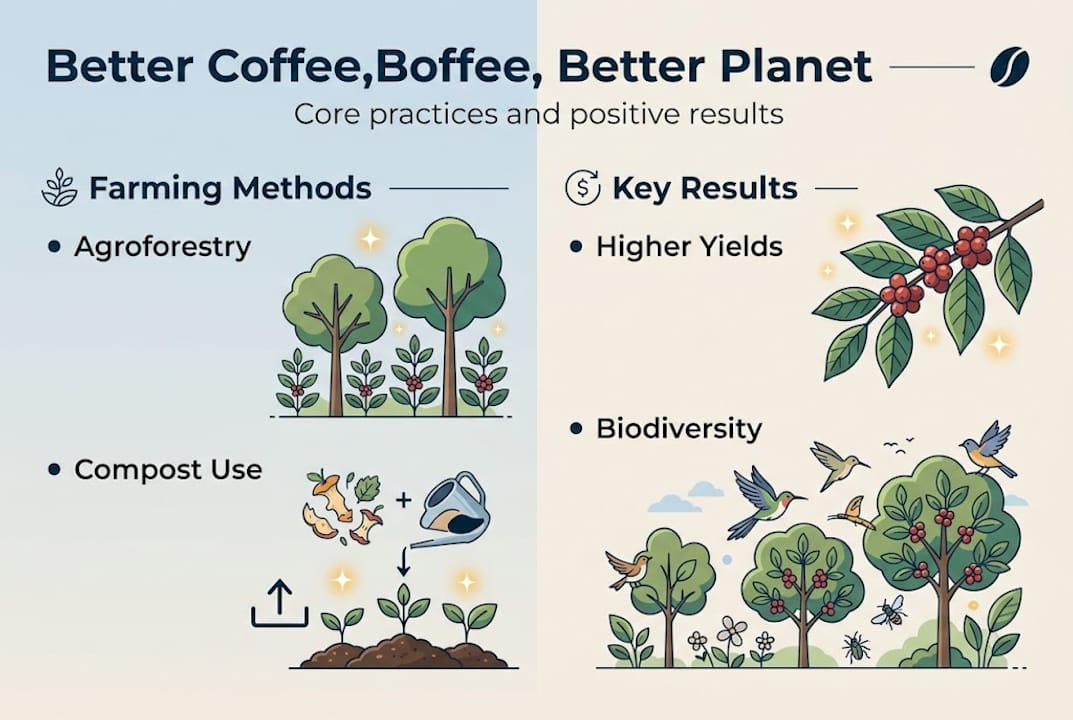
Here is how the outcomes compare across key metrics:
| Metric | Sustainable farming | Conventional farming |
|---|---|---|
| Average yield change | +15 to 25% over 5 years | Declining after soil depletion |
| Coffee Leaf Rust incidence | Reduced by up to 40% | High, especially in monocultures |
| Farmer income premium | 20 to 30% higher | Baseline or declining |
| Soil organic matter | Increasing | Decreasing |
| Biodiversity index | High | Low |
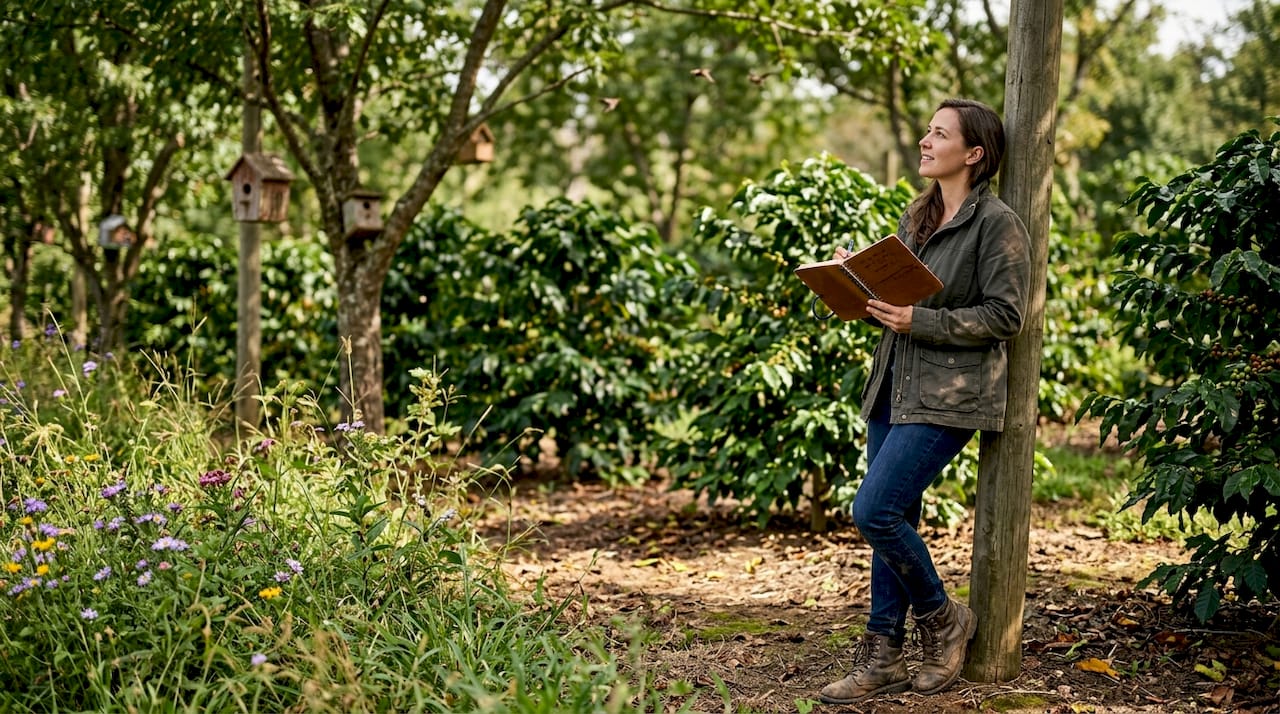
Beyond the numbers, biodiversity plays a direct role in cup quality. Farms with diverse canopy cover and healthy soil microbiomes produce Arabica beans with greater flavor complexity. The slower ripening that shade provides allows more time for the development of the acids, sugars, and aromatic precursors that specialty roasters prize.
For coffee lovers who care about what is in their cup, understanding the Arabica bean advantages tied to sustainable farming makes the connection between growing method and flavor much clearer. Climate resilience also matters here. As growing regions face more erratic rainfall and rising temperatures, farms with diverse ecosystems and healthy soils are better equipped to absorb those shocks without catastrophic crop loss.
Certifications, challenges, and controversies
Certifications were designed to give consumers a shortcut. Instead of researching every farm, you trust the logo. But the reality is more complicated than any logo can capture.
Rainforest Alliance, Fairtrade, and Organic certifications each address different priorities. Rainforest Alliance focuses on biodiversity, water use, and worker rights. Fairtrade sets a minimum price floor to protect farmers from market crashes. Organic prohibits synthetic inputs. All three have genuine value, but none is a complete picture on its own.
Here is a quick comparison:
| Certification | Primary focus | Key limitation |
|---|---|---|
| Rainforest Alliance | Ecosystem and labor standards | Audit quality varies by region |
| Fairtrade | Minimum price and cooperative structure | Price floor often below market in boom years |
| Organic | No synthetic inputs | Does not address labor or income directly |
The deeper issue is access. Certification costs can be significant for smallholders, and the benefits are not always distributed evenly within cooperatives. A large cooperative may carry certified status while individual member farms vary widely in their actual practices.
In specialty coffee circles, the conversation has shifted. Organic certification, once a badge of honor, is losing ground to direct relationships and quality-driven sourcing. Buyers increasingly want to know the farmer’s name, the farm’s elevation, and the processing method, not just whether a third party audited the operation.
The Regenerative certification announced by Rainforest Alliance is a step forward, raising the bar beyond compliance toward active land restoration. But it is still new, and uptake among smallholders will depend heavily on cost support and technical assistance.
Challenges for farmers also include aging coffee trees, labor shortages in rural areas, and the economic pressure to cut corners when prices drop. For a full breakdown of what labels actually mean, the coffee certification explained resource is worth reading alongside the benefits of ethically sourced coffee for the consumer side of the equation.
Pro Tip: When evaluating a coffee brand’s sustainability claims, ask whether they publish farm-level data, visit producers directly, or support programs that go beyond certification compliance. The best brands can answer those questions without hesitation.
How drinkers and brands drive positive change
Certifications set a floor. Consumers and specialty brands can raise the ceiling.
Your purchasing decisions are not passive. Every bag you buy sends a signal about what you value. Producer-led associations and engaged consumer communities boost self-governance and fairness in regions where formal certification falls short. That is not a small thing.
Here are concrete steps you can take:
- Buy direct or near-direct. Choose roasters who name their farm partners and publish sourcing details. The closer the relationship, the more transparent the supply chain.
- Learn the farm story. Origin information should go beyond country of origin. Look for farm name, region, altitude, and processing method.
- Support regenerative and climate-smart programs. Organizations like World Coffee Research develop climate-resilient Arabica varieties that help farmers adapt without sacrificing quality.
- Ask your roaster hard questions. How often do they visit farms? Do they pay above the commodity price? Do they offer pre-financing to producers?
- Reward transparency, not just logos. A brand that openly discusses trade-offs and ongoing challenges is often more trustworthy than one with a wall of certification badges.
“When a customer asks where their coffee comes from and actually cares about the answer, it changes what we ask of our suppliers.” — Specialty roaster, Vancouver
Brands play an equally important role. Specialty companies that invest in ethical sourcing in coffee and build long-term relationships with growers create stability that no certification can replicate. The growers’ ethical approaches that produce the best cups are almost always tied to those kinds of partnerships.
Pro Tip: When choosing specialty beans, look for evidence of multi-year purchasing commitments with producers. A roaster who returns to the same farm year after year is investing in that farm’s future, not just buying a lot.
Why sustainable coffee is still a moving target
Here is the uncomfortable truth we do not say enough: there is no such thing as a perfectly sustainable cup of coffee. Not yet. And chasing that ideal without acknowledging the trade-offs does more harm than good.
Smallholder farmers face knowledge gaps, aging trees, economic limits, and labor shortages, even as they carry the weight of consumer ideals for sustainability. When we demand perfection from a farmer earning a few dollars a day, we are not being ethical. We are being unrealistic.
What actually moves the needle is incremental progress built on honest relationships. A farmer who replaces 20% of their monoculture with shade trees this year is doing something meaningful, even if their operation is not yet certified. A brand that pays 15% above the commodity price and visits their partners annually is creating more impact than one with three logos and no farm visits.
At House Coffee, we believe the goal is not a static label but a direction of travel. Transparency, long-term grower relationships, and a genuine commitment to improvement matter more than any single certification. If you want to understand why that philosophy shapes everything we source, the ethical coffee impact piece lays it out plainly.
Sustainability in coffee is a process, not a destination. The brands and consumers who understand that are the ones actually helping farmers move forward.
Find exceptional specialty coffee raised with care
Understanding sustainable farming is the first step. Choosing coffee that reflects those values is the next one.

At House Coffee, every bean in our collection is selected with both quality and ethics in mind. We work with growers who practice the methods you have just read about, from shade-grown Arabica to regenerative soil care, and we share those stories openly. Whether you are building a daily ritual or looking for a meaningful gift, our specialty coffee options offer a direct way to support the farming practices that matter. For cafes and businesses ready to source with intention, our wholesale specialty coffee program connects you with exceptional lots and the growers behind them.
Frequently asked questions
How does agroforestry benefit coffee farming?
Agroforestry, or shade-grown coffee, increases biodiversity and improves soil health compared to monocultures, and it enhances the flavor complexity of specialty Arabica by slowing the ripening process.
Are certifications like Fairtrade or Rainforest Alliance enough?
Certifications promote better practices, but certification benefits are uneven and costs can be high for smallholders, so they work best when paired with direct relationships and transparent sourcing.
What practical steps can consumers take to support sustainable coffee?
Buy from brands with transparent sourcing, look for regenerative and climate-friendly programs, and support producer-led initiatives that add fairness where certifications fall short.
Does sustainable farming improve coffee flavor?
Yes. Shade-grown methods and regenerative practices slow bean development and build richer soil, both of which enhance the flavor complexity found in high-quality Arabica.
Recommended
-
Posted in
en, sustainable coffee farming