Step by step coffee tasting guide specialty coffee at home
You brew your morning coffee with care, but something feels missing. The tasting notes on the bag promise bright citrus and sweet chocolate, yet all you taste is coffee. Many specialty coffee lovers face this frustration daily, unable to unlock the complex flavors hiding in their cup. Learning to taste coffee professionally transforms this experience. This guide walks you through the Specialty Coffee Association cupping protocol, giving you the tools and techniques to discover every nuance in your favorite beans and elevate your daily ritual from routine to revelation.
Table of Contents
- What You Need: Equipment And Setup For Coffee Tasting
- Step-By-Step Coffee Tasting Procedure Using The SCA Protocol
- Common Challenges And How To Improve Your Coffee Tasting Skills
- How To Interpret Your Coffee Tasting Results And What They Mean
- Enhance Your Tasting With Specialty Coffee And Brewing Gear
- FAQ
Key takeaways
| Point | Details |
|---|---|
| Standardized tasting reveals hidden flavors | Following the SCA protocol helps you identify subtle notes you’ve been missing in your daily coffee |
| Fresh grinding preserves aromatic compounds | Grinding within 15 minutes of tasting ensures you capture the full spectrum of volatile flavors |
| Slurping aerates coffee for full assessment | This technique spreads coffee across your palate and enhances retronasal aroma perception |
| Practice builds sensory precision | Regular cupping sessions train your palate to detect and articulate specific flavor characteristics |
| Scoring guides coffee selection | Understanding the 100-point scale helps you choose beans that match your taste preferences |
What you need: equipment and setup for coffee tasting
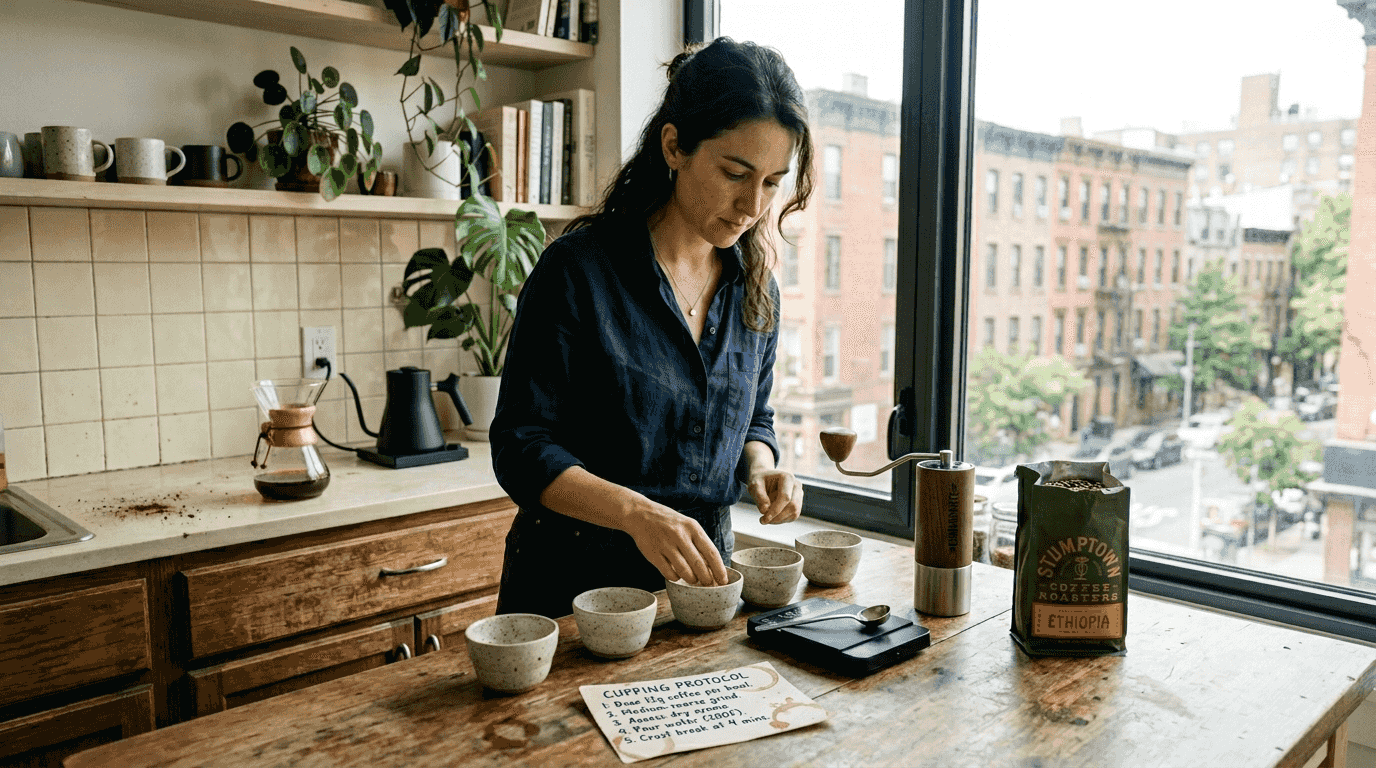
Setting up for coffee tasting requires precision tools and the right environment. You need a burr grinder for consistent particle size, a digital scale accurate to 0.1 grams, cupping bowls or wide-mouth glasses, cupping spoons, a timer, and a reliable hot water source. The beans themselves matter just as much. Choose specialty grade coffee and grind immediately before cupping to preserve volatile aromatic compounds that define flavor.
Your tasting space shapes results more than you might expect. Find a quiet room free from strong odors like perfume, cooking smells, or air fresheners. Natural light works best for evaluating color and clarity. Temperature stability matters too, so avoid drafty areas or direct sunlight that might cool your samples unevenly. A clean palate is essential, so skip coffee, strong flavors, or smoking at least 30 minutes before your session.
Quality water makes or breaks your tasting. Use filtered water heated to 200°F, just off the boil. Hard water or chlorinated tap water masks delicate notes and skews your perception. Keep your equipment spotless between sessions. Residual oils from previous coffees contaminate fresh samples and muddy your evaluation.
| Item | Purpose | Notes | | — | — | | Burr grinder | Consistent particle size for even extraction | Blade grinders create uneven grounds | | Digital scale | Precise coffee to water ratio | Accuracy to 0.1g recommended | | Cupping bowls | Wide surface area for aroma evaluation | 6-8 oz capacity ideal | | Cupping spoons | Deep bowl for slurping technique | Stainless steel preferred | | Timer | Track steeping and evaluation phases | 4-minute steep is standard | | Filtered water | Clean flavor without interference | Heat to 200°F |
Pro Tip: Preheat your cupping bowls with hot water before adding coffee. This simple step stabilizes temperature during evaluation and prevents premature cooling that dulls flavor perception.
Once you have your equipment ready, the step-by-step coffee tasting guide specialty coffee approach ensures you extract maximum information from every sample. Organization matters. Line up your samples, label them clearly, and prepare your scoring sheets before you begin. This preparation creates a smooth workflow that lets you focus entirely on sensory evaluation rather than scrambling for tools mid-session.
Step-by-step coffee tasting procedure using the SCA protocol
The Specialty Coffee Association cupping protocol provides the framework professionals use worldwide. The SCA cupping protocol standardizes evaluation so cuppers can compare results objectively. Following these steps transforms casual coffee drinking into precise sensory analysis that reveals what makes each coffee unique.
-
Weigh 8.25 grams of whole bean coffee per 150ml of water. This ratio provides optimal extraction for evaluation. Grind the coffee to medium-coarse consistency immediately before brewing, ideally within 15 minutes. Freshly ground coffee releases aromatic compounds that dissipate quickly.
-
Lean close to the dry grounds and inhale deeply. Note the fragrance, the aromatic impression of dry coffee. You might detect floral notes, fruit, nuts, or chocolate. Write down your first impressions. These fleeting aromas disappear once water hits the grounds.
-
Start your timer and pour 200°F water directly onto the grounds, saturating them completely. A crust of grounds will float to the surface. Let the coffee steep undisturbed for exactly 4 minutes. This controlled steeping time ensures consistent extraction across all samples.
-
After 4 minutes, break the crust by gently pushing the floating grounds aside with your spoon. As the crust breaks, lean in and smell the released aroma. This wet aroma differs dramatically from the dry fragrance. The intensity and character of this aroma tell you about the coffee’s freshness and roast development.
-
Use two spoons to skim off the foam and floating grounds from the surface. Remove as much as possible to prevent bitter particles from contaminating your taste evaluation. The liquid should be relatively clear.
-
Wait until the coffee cools to around 160°F, then begin slurping. Dip your spoon about halfway into the liquid, bring it to your lips, and slurp forcefully to aerate the coffee. This technique spreads liquid across your entire palate and allows aromatic compounds to reach your nasal passages through retronasal olfaction. The sound might feel awkward at first, but it’s essential for complete flavor assessment.
-
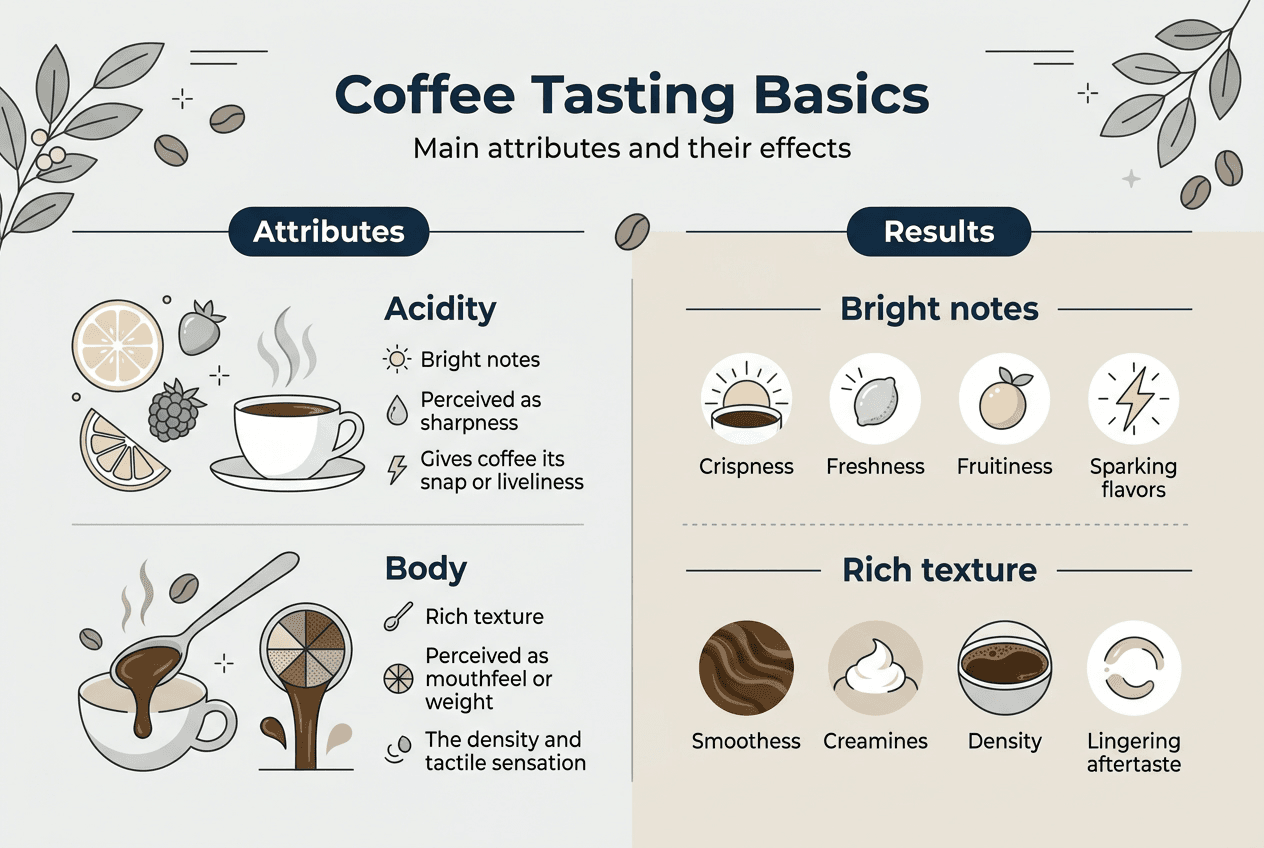
Evaluate each attribute systematically. Score fragrance and aroma first, then move to flavor, aftertaste, acidity, body, balance, and overall impression. The SCA uses a 100-point scale where specialty grade coffee scores 80 or above. Each attribute receives points based on intensity and quality. Flavor captures the mid-palate impression, while aftertaste measures the length and pleasantness of lingering notes. Acidity refers to brightness and liveliness, not sourness. Body describes the tactile sensation, the weight and texture on your tongue.
Common flavor notes you might identify include:
- Fruity: berry, citrus, stone fruit, tropical fruit
- Floral: jasmine, rose, lavender, chamomile
- Sweet: caramel, honey, brown sugar, vanilla
- Nutty: almond, hazelnut, peanut, walnut
- Chocolate: dark chocolate, cocoa, milk chocolate
- Spicy: cinnamon, clove, pepper, cardamom
Pro Tip: Practice slurping with different volumes and speeds to find your technique. A consistent slurp creates a repeatable sensory experience that improves your ability to compare coffees accurately. Start with gentle slurps and gradually increase intensity as you build confidence.
As the coffee cools further, continue tasting. Flavors evolve at different temperatures, revealing new characteristics. How to taste coffee flavors naturally becomes easier with practice, as your sensory memory builds a library of reference points. Take notes throughout the process. Capture your impressions immediately, as flavors fade from memory quickly. The coffee cupping flavor accuracy home baristas achieve improves dramatically with systematic note-taking and regular practice sessions.

Common challenges and how to improve your coffee tasting skills
Even experienced cuppers face obstacles that compromise their evaluations. Recognizing these pitfalls helps you develop more reliable tasting skills. Inconsistent grinding ranks among the most common mistakes. Particle size variation creates uneven extraction, where fine particles over-extract and coarse particles under-extract simultaneously. This muddles flavor clarity and makes accurate assessment impossible.
Rushing through the tasting process sabotages results. Each phase of cupping serves a purpose, from dry fragrance to cool-temperature flavor assessment. Skipping steps or hurrying means missing crucial information. Give yourself time to experience the full evolution of flavors as temperature drops. The coffee that tastes flat at 180°F might reveal stunning complexity at 140°F.
Ignoring aroma cuts your perception in half. Smell contributes enormously to what we perceive as taste. If you focus only on the liquid in your mouth, you miss the aromatic dimension that defines specialty coffee. Always evaluate fragrance and aroma with the same attention you give to flavor.
Subjective bias affects every cupper. Research shows preferences drove scoring patterns far more than the standardized form suggested. Cuppers were consistent with themselves but varied widely from each other. This inter-rater variability reveals how personal taste influences supposedly objective evaluation. Awareness of your biases is the first step toward managing them.
Individual cuppers were very consistent with themselves, but not consistent with each other, and preferences drove scoring patterns far more than the form suggested.
Regular practice builds sensory memory and calibration. Your palate learns to recognize and categorize flavors through repeated exposure. The more coffees you taste, the more reference points you develop. This experiential learning cannot be rushed or replaced by reading about coffee.
Skill-building exercises accelerate your development:
- Conduct blind tastings where someone else prepares samples without revealing origins
- Use coffee aroma kits to train your nose on isolated aromatic compounds
- Cup the same coffee multiple times to understand your consistency
- Compare your scores with experienced cuppers to identify gaps in perception
- Focus on one attribute at a time during practice sessions
- Taste coffees from different origins side by side to highlight regional characteristics
Pro Tip: Keep a detailed tasting journal with dates, coffee origins, roast levels, and your complete sensory notes. Review past entries before new sessions to refresh your sensory memory and track how your palate evolves over time. Comparing current impressions with previous evaluations of the same coffee reveals your progress and helps identify persistent blind spots.
The specialty coffee tasting tips home baristas apply help you move beyond basic appreciation to genuine expertise. Patience and persistence matter more than natural talent. Even professional Q-graders who certify coffee quality spend years refining their skills through daily practice and calibration sessions with peers.
How to interpret your coffee tasting results and what they mean
Understanding your scores transforms raw numbers into actionable insights. Professional coffee graders score coffees on a 100-point scale with coffees scoring 80 or above considered specialty grade. This threshold separates exceptional coffee from commodity offerings. Within specialty grade, subtle differences in scores reflect significant quality variations.
| Score Range | Quality Level | Recommended Usage |
|---|---|---|
| 90-100 | Outstanding | Reserve for special occasions, pour-over, careful brewing |
| 85-89.99 | Excellent | Daily specialty brewing, espresso, featured offerings |
| 80-84.99 | Very Good | Regular rotation, blends, reliable quality |
| Below 80 | Below Specialty | Commercial grade, not recommended for specialty preparation |
Each scored attribute tells a specific story about the coffee. Acidity describes brightness and liveliness, the sparkling quality that makes coffee feel alive on your palate. High acidity coffees taste vibrant and complex, while low acidity coffees feel smooth and mellow. Neither is inherently better, but understanding your preference guides bean selection.
Body refers to tactile weight and texture. Full-bodied coffees feel rich and coating, like whole milk. Light-bodied coffees feel delicate and tea-like. Medium body falls between these extremes. Body comes from dissolved solids and oils in the brew. Processing method and roast level heavily influence body perception.
Balance measures how well different elements harmonize. A balanced coffee presents acidity, sweetness, and bitterness in pleasing proportion, with no single element dominating. Imbalanced coffees might taste excessively sour, overly bitter, or one-dimensionally sweet. Balance often separates good coffees from great ones.
Aftertaste describes the flavors that linger after swallowing. Length matters as much as quality. Exceptional coffees leave pleasant impressions that evolve and persist for minutes. Poor aftertastes fade quickly or turn unpleasant. A clean, sweet aftertaste indicates careful processing and proper roasting.
Practical interpretations guide your coffee choices:
- High acidity indicates brightness perfect for morning brewing and pour-over methods
- Full body adds richness ideal for espresso and milk-based drinks
- Excellent balance means the coffee shines in any preparation method
- Long, sweet aftertaste suggests the coffee will taste great as it cools
- High overall scores justify premium pricing and special brewing attention
Use your scores to adjust brewing parameters. If a coffee scores high in acidity but low in body, try a slightly finer grind or longer brew time to extract more solids. If body overwhelms delicate flavors, coarsen your grind or reduce brew time. Your cupping scores provide a baseline that informs how you extract the coffee for daily enjoyment. The coffee flavor profiles explained resource helps connect cupping observations to brewing decisions that optimize your coffee experience.
Enhance your tasting with specialty coffee and brewing gear
Applying your refined tasting skills requires exceptional coffee and reliable tools. House Coffee’s curated specialty coffee selection provides the quality beans your trained palate deserves. Each origin tells a unique story through its flavor profile, from bright Ethiopian naturals to rich Colombian washed coffees. Tasting these distinct profiles side by side deepens your appreciation and sharpens your sensory discrimination.
Consistent preparation depends on proper equipment. The brewing essentials collection includes precision tools that support repeatable results. Quality cupping spoons, accurate scales, and proper vessels make the difference between guesswork and genuine evaluation. When you control variables through reliable gear, your tasting notes reflect the coffee itself rather than equipment inconsistencies.
Explore the comprehensive brewing guides to complement your tasting practice. These resources connect cupping insights to daily brewing, helping you translate professional evaluation skills into better coffee at home. Understanding what you taste and why empowers you to brew with intention, adjusting parameters to highlight the characteristics you most enjoy.
FAQ
What is the best grind size for coffee cupping?
Medium-coarse grind works best for coffee cupping, similar to coarse sea salt. This size allows proper extraction during the 4-minute steep without over-extracting bitter compounds or under-extracting desirable flavors. Grinding immediately before cupping preserves aromatic compounds that define the coffee’s character. Consistency matters more than the exact size, so invest in a quality burr grinder that produces uniform particles.
Why is slurping important in coffee tasting?
Slurping aerates the coffee and spreads it across your entire palate, allowing you to perceive flavors more completely. This technique also enables retronasal aroma perception, where aromatic compounds travel from your mouth to your nasal passages. Without slurping, you miss crucial aromatic dimensions that define specialty coffee. The forceful intake of air creates a fine mist that activates taste receptors and olfactory sensors simultaneously, providing the full sensory picture professionals rely on for accurate evaluation.
How do I improve consistency in my coffee cupping scores?
Practice regularly with the same coffees to establish baseline references. Keep detailed notes for every session and compare your scores over time to identify patterns in your evaluation. Cup with other experienced tasters and discuss your impressions to calibrate your palate against theirs. Research shows preferences drove scoring patterns more than objective criteria, so awareness of your biases helps you compensate for them. Use blind tastings to eliminate preconceptions about origin or price that might influence your judgment.
How often should I practice coffee cupping at home?
Cup at least once weekly to maintain and develop your palate. Professional cuppers taste daily to keep their sensory skills sharp and their reference library current. Even twice monthly practice yields significant improvement over sporadic sessions. Consistency matters more than duration, so short focused sessions beat occasional marathon tastings. Your sensory memory strengthens through regular reinforcement, making frequent brief practices more effective than infrequent extended ones.
Can I use the same coffee multiple times for cupping practice?
Yes, cupping the same coffee repeatedly builds valuable consistency and reveals how your perception changes. Use fresh samples each time rather than reheating or reusing grounds. Tasting the same coffee across multiple sessions helps you understand normal variation in your scoring and identifies which attributes you perceive most reliably. This practice also teaches you how coffee evolves with rest time after roasting, as the same beans taste different at 3 days post-roast versus 14 days post-roast.
Recommended
-
Posted in
en, step by step coffee tasting