Defining Hand-Crafted Coffee: Sourcing, Craft, Flavor
Defining Hand-Crafted Coffee: Sourcing, Craft, Flavor
Not all specialty coffee is truly hand-crafted, and the confusion between artisan labels and genuine manual processes leaves many coffee lovers uncertain about what they’re buying. Hand-crafted coffee isn’t just about the final brew in your cup. It’s defined by meticulous attention at every stage: sourcing exceptional beans, roasting in small batches with precision, and brewing with manual control. This article clarifies what hand-crafted coffee actually means, exploring the sourcing standards, roasting techniques, and brewing methods that distinguish it from mass-market options. You’ll discover the nuances that make each cup an expression of skill and care, and why understanding these processes transforms how you experience coffee.
Table of Contents
- What truly defines hand-crafted coffee?
- Sourcing: The foundation of quality
- Small-batch roasting: Preserving origin flavors
- Manual brewing methods: Control and clarity in the cup
- Nuances and edge cases: Beyond scorecards
- Discover artisan coffee and start your own journey
- Frequently asked questions
Key Takeaways
| Point | Details |
|---|---|
| Hand-crafted definition | Hand-crafted coffee means manual processes throughout sourcing, roasting, and brewing are prioritized over automation and mass production. |
| Premium sourcing focus | Only the highest-quality beans, traceability, and fair trade practices make the cut for hand-crafted coffee. |
| Small-batch roasting | Roasting in small batches preserves each bean’s unique flavors and ensures artisan attention to detail. |
| Manual brewing impact | Manual brewing methods like pour-over and AeroPress highlight flavors otherwise lost in automated brewing. |
| Evolving standards | Quality, sustainability, and consumer values continually shape what defines hand-crafted coffee today. |
What truly defines hand-crafted coffee?
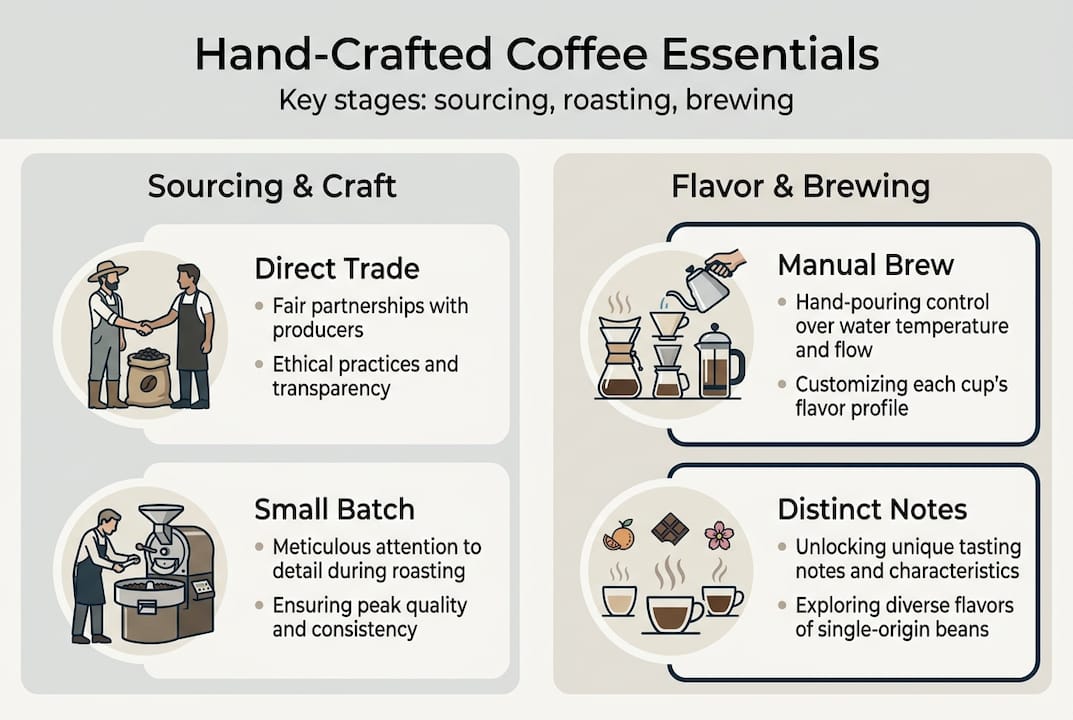
Hand-crafted coffee stands apart from both mass-market products and vaguely labeled specialty offerings through its commitment to manual processes and traceability. While commercial coffee prioritizes volume and consistency, hand-crafted coffee emphasizes quality at every touchpoint. The term overlaps with artisan and third-wave coffee, but the defining characteristic is the deliberate human involvement in sourcing, roasting, and brewing.
Three pillars form the foundation:
- Manual methods: Hands-on techniques replace automated systems, allowing roasters and baristas to respond to each bean’s unique characteristics
- Traceability: Every batch connects to specific farms, regions, and harvest details, ensuring transparency
- Small batches: Limited production runs enable precision and quality control impossible at industrial scale
- Artisan skill: Experienced professionals make real-time adjustments based on sensory feedback, not just programmed parameters
As one specialty roaster explains, “Hand-crafted coffee is about honoring the bean’s journey from farm to cup. Every decision we make preserves the flavors that farmers worked months to develop.” This philosophy separates genuine craftsmanship from marketing buzzwords.
The distinction matters because hand-crafted coffee emphasizes quality through deliberate choices, not shortcuts. While some brands use “specialty” as a catch-all term, hand-crafted coffee requires documented practices across the supply chain. Understanding specialty coffee standards helps you recognize authentic quality, and exploring coffee craftsmanship reveals why these methods produce superior results.
Sourcing: The foundation of quality
Exceptional coffee begins long before roasting. Sourcing practices determine the potential locked inside each bean, and hand-crafted coffee demands rigorous selection criteria. The Specialty Coffee Association uses a 100-point scale, and beans scoring 80+ represent the top 5-10% of global production. But numbers alone don’t tell the complete story.
| Attribute | Commodity Coffee | Specialty Coffee | Hand-Crafted Coffee |
|---|---|---|---|
| Origin | Blended, unknown | Single-origin | Single-origin, traceable to farm |
| Process | Machine harvested | Selective picking | Hand-picked, sorted |
| Price | Market rate | 10-20% premium | 20-50% premium |
| Traceability | None | Region | Farm, lot, harvest date |
Hand-crafted sourcing goes beyond scores. It includes:
- Direct trade relationships: Roasters work directly with farmers, ensuring fair compensation and quality feedback loops
- High-altitude Arabica: Beans grown above 1,200 meters develop complex flavors through slower maturation
- Hand-picking: Selective harvesting ensures only ripe cherries make it to processing, eliminating defects
- Transparent pricing: Premiums of 20-50% above commodity rates support sustainable farming and quality investment
The SCA Q Grader certification represents professional cupping expertise. These trained evaluators assess aroma, flavor, aftertaste, acidity, body, balance, and uniformity. A score of 80-84.99 qualifies as specialty, while 85-89.99 indicates excellent quality, and 90+ represents outstanding coffee. Hand-crafted roasters often seek beans in the 84-88 range, where exceptional character meets reasonable pricing.
Why does methodical sourcing matter for taste? Because flavor compounds develop during growth, and processing methods preserve or destroy them. A washed Ethiopian Yirgacheffe offers bright citrus notes because high elevation, careful picking, and clean processing protected delicate aromatics. Mass-market coffee can’t replicate this because shortcuts at origin eliminate the compounds that create complexity. Learning more through our coffee selection guide helps you identify these quality markers when shopping.
Small-batch roasting: Preserving origin flavors
Roasting transforms green coffee into the aromatic beans you grind and brew, and this stage makes or breaks hand-crafted quality. While commercial roasters process thousands of pounds per batch using automated profiles, artisan roasters work with 5-50 pound batches, monitoring every phase manually. This hands-on approach preserves the origin characteristics that sourcing established.
The roasting process follows distinct phases:
- Charge: Green beans enter the preheated roaster, beginning moisture evaporation and chemical changes
- Color development: Beans transition from green to yellow to brown as Maillard reactions create flavor compounds
- First crack: Beans expand and crack audibly as internal pressure releases, signaling light roast territory
- Development: Roasters control time after first crack to balance acidity, sweetness, and body
Small batches allow roasters to respond to real-time feedback. They adjust heat, airflow, and timing based on bean density, moisture content, and visual cues. A Kenyan coffee might need aggressive heat early to develop bright acidity, while a Brazilian bean benefits from gentler development to enhance chocolate notes. Automated systems can’t make these nuanced decisions.
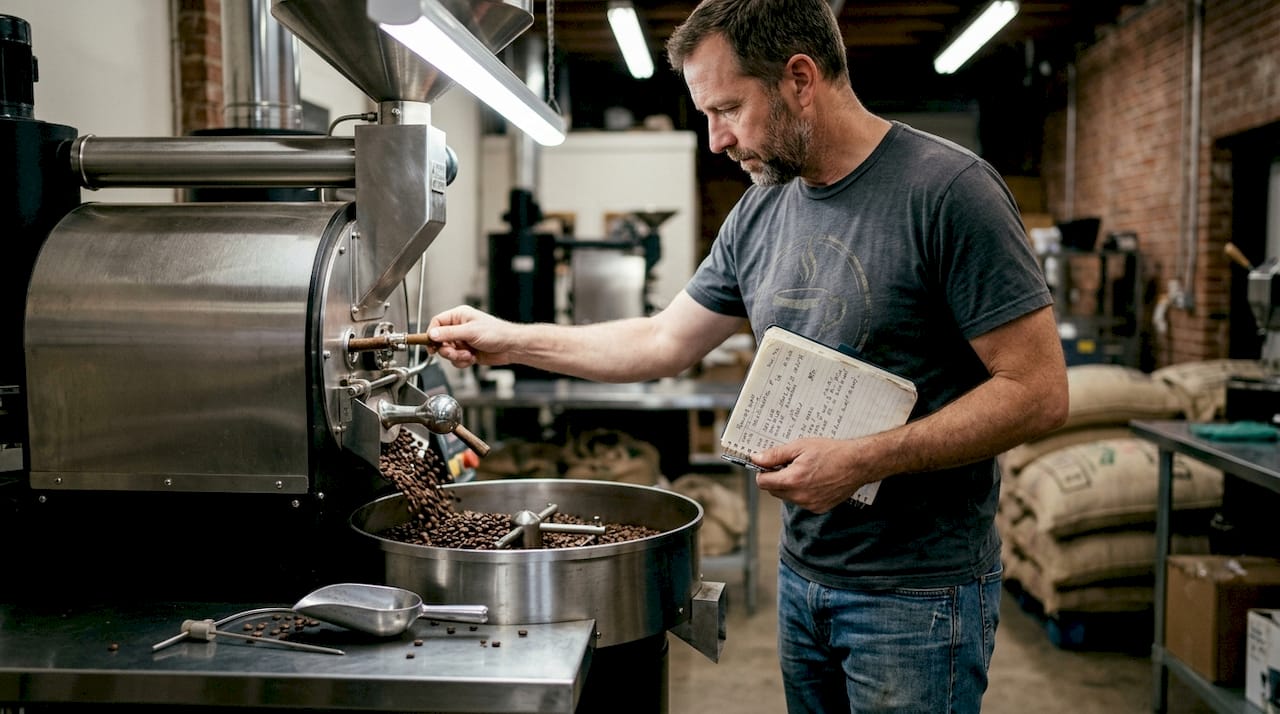
Pro Tip: Well-roasted coffee shows even color without scorching or pale spots. Smell the beans before grinding. You should detect clear aromatics like fruit, chocolate, or nuts, not smoky or flat odors. Uneven roasting or over-development kills the flavors you paid premium prices to enjoy.
Light to medium roasts dominate hand-crafted coffee because they preserve origin character. Darker roasts develop roast flavor that masks terroir, which defeats the purpose of careful sourcing. By stopping development at the right moment, roasters let you taste the farm, not just the roaster. Exploring our guide on roasting explained reveals how these decisions shape your cup, and understanding coffee flavor profiles helps you appreciate what skilled roasting achieves.
Manual brewing methods: Control and clarity in the cup
After sourcing exceptional beans and roasting them with precision, brewing determines whether you actually taste that quality. Manual brewing methods emphasize control, allowing you to adjust variables and extract the flavors roasters worked to preserve. Pour-over, AeroPress, and espresso represent three approaches that exemplify hand-crafted philosophy.
| Method | Coffee:Water Ratio | Temperature | Brew Time | Flavor Profile |
|---|---|---|---|---|
| Pour-over | 1:15 to 1:17 | 195-205°F | 2.5-4 min | Clean, bright, nuanced |
| AeroPress | 1:14 to 1:16 | 175-185°F | 1-2 min | Full-bodied, versatile |
| Espresso | 1:2 | 195-205°F | 25-30 sec | Concentrated, complex |
Each method offers distinct advantages. Pour-over delivers clarity and highlights delicate notes, making it ideal for floral Ethiopians or fruity Kenyans. AeroPress provides versatility and body, working well with a wide range of origins and roast levels. Espresso concentrates flavors into an intense shot, revealing both excellence and flaws with brutal honesty.
Key brewing steps for manual methods:
- Measure precisely: Use a scale to weigh coffee and water, ensuring consistency
- Control temperature: Water too hot extracts bitterness, too cool leaves flavors locked in the grounds
- Time extraction: Under-extraction tastes sour and thin, over-extraction turns bitter and astringent
- Adjust technique: Modify grind size, agitation, and pour patterns based on taste feedback
Pro Tip: Watch the bloom when you first add water to fresh coffee. Grounds should bubble and expand as trapped CO2 escapes. Minimal bloom indicates stale coffee that won’t deliver full flavor regardless of your technique. Gentle agitation during bloom helps even saturation and improves extraction uniformity.
The Specialty Coffee Association and World AeroPress Championship have established empirical benchmarks, but hand-crafted brewing values sensory feedback over rigid rules. If your Ethiopian tastes better at 1:16 instead of 1:15, trust your palate. The goal is extracting what makes each coffee unique, not hitting arbitrary targets. Our manual brewing methods overview and detailed brewing guide provide frameworks you can adapt to your preferences. For AeroPress enthusiasts, this comprehensive brewing guide offers advanced techniques worth exploring.
Nuances and edge cases: Beyond scorecards
While SCA scores and brewing ratios provide useful frameworks, hand-crafted coffee involves subtleties that numbers can’t fully capture. Elite coffees often score 86+ on the SCA scale, placing them in rarefied territory. Yet artisan roasters sometimes choose 84-point beans with exceptional character over higher-scoring but less distinctive options. The score indicates quality potential, but craft determines what you actually taste.
Emerging considerations reshaping the definition:
- Sustainability metrics: The SCA Coffee Value Assessment now includes environmental impact, labor practices, and community investment alongside cup quality
- Consumer values: Traceability and ethical sourcing increasingly influence purchasing decisions, making transparency essential
- Processing innovation: Experimental fermentation and drying methods create new flavor possibilities that traditional scoring doesn’t fully address
- Climate adaptation: As growing regions shift, hand-crafted coffee must balance tradition with necessary changes in sourcing and processing
Espresso presents particular complexity. Traditional standards suggest 18-20g dose, 1:2 ratio, and 25-30 second extraction, but artisan cafes increasingly experiment beyond these boundaries. Some pull longer ratios for filter-like clarity, others use pressure profiling to emphasize specific flavor phases. The craft lies in intentional deviation based on desired outcomes, not arbitrary rule-breaking.
Definitions will continue evolving as coffee science advances and consumer expectations shift. What matters for hand-crafted coffee is maintaining the core commitment to manual processes, quality sourcing, and skilled execution. Whether that means adhering to established benchmarks or thoughtfully pushing boundaries, the focus remains on honoring the bean and delivering exceptional experiences. Exploring coffee flavor profiles helps you develop the palate to appreciate these nuances and make informed choices.
Discover artisan coffee and start your own journey
Understanding what defines hand-crafted coffee transforms how you shop, brew, and taste. The meticulous processes behind sourcing, roasting, and brewing aren’t abstract concepts but practical choices that determine whether your morning cup delivers genuine complexity or generic caffeine. You don’t need to become an expert overnight, but knowing what to look for helps you invest in coffee that rewards attention.
We’ve curated collections that embody these hand-crafted principles, from single-origin beans roasted in small batches to brewing equipment that gives you manual control. Our specialty coffee collection features traceable, ethically sourced options across flavor profiles, while our specialty coffee page provides detailed origin stories and tasting notes. Whether you’re exploring pour-over for the first time or refining your espresso technique, our brewing essentials support your journey toward better coffee. Start with one exceptional bag and experience the difference that genuine craftsmanship makes.
Frequently asked questions
What makes hand-crafted coffee different from regular coffee?
Hand-crafted coffee uses manual processes across sourcing, roasting, and brewing, emphasizing premium beans, traceability, and artisan skill. This delivers flavor clarity and complexity that mass-market automation can’t replicate.
How do SCA scores impact the definition of hand-crafted coffee?
Scores of 80+ indicate specialty quality, but hand-crafted coffee also considers sustainability, direct trade relationships, and processing methods beyond the numerical rating. The score is a starting point, not the complete picture.
Are specific brewing methods required for hand-crafted coffee?
Manual methods like pour-over and AeroPress are preferred because they offer precise control over extraction variables. However, any approach that emphasizes intentional technique and quality can embody hand-crafted values.
Is sustainability an essential part of hand-crafted coffee?
Increasingly, yes. The SCA Coffee Value Assessment now includes sustainability alongside cup quality, and consumers expect traceability and ethical sourcing. Hand-crafted coffee aligns with these values through direct trade and transparent practices.
Can I make hand-crafted coffee at home?
Absolutely. Start with freshly roasted, traceable beans, use a scale to measure precisely, and choose a manual brewing method that gives you control. The craft is in the attention you bring to each step, not expensive equipment.
Recommended
- Defining coffee craftsmanship for premium brewing – House Coffee
- Specialty Coffee Terminology: Enhance Your Coffee Journey – House Coffee
- Step by Step Specialty Coffee Selection Guide for Home – House Coffee
- Wholesale Decaf Coffee | Swiss Water Process | Devon Somerset
-
Posted in
defining hand-crafted coffee, en