Water quality and coffee flavor: what brewers must know
TL;DR:
- Water quality greatly impacts coffee flavor, with minerals affecting extraction and taste.
- Ideal brewing water has specific TDS, alkalinity, and pH levels, with chlorine removed.
- Simple steps like filtration and remineralization improve water, enhancing overall coffee quality.
Two cups brewed from the exact same bag of single-origin Arabica. Same grind size, same temperature, same brew time. Yet one tastes bright and complex, and the other tastes flat and faintly chemical. The difference? The water. Most home brewers obsess over beans, grinders, and pour technique, but the SCA recommends TDS ~150 ppm for brewing water, a detail most people never consider. Water is not a passive ingredient. It is the medium that either unlocks or suppresses everything you love about a great cup. This guide breaks down exactly what water does in your brew, what makes it good or bad, and how to fix it at home without a chemistry degree.
Table of Contents
- Why water quality is crucial for great coffee
- The science: What makes water ‘good’ for brewing?
- Comparing water standards: SCA guidelines vs. expert perspectives
- Practical tips: How to get better brewing water at home
- Our take: What most guides miss about water in coffee brewing
- Brew better coffee with the right beans and tools
- Frequently asked questions
Key Takeaways
| Point | Details |
|---|---|
| Water affects flavor | The quality and chemistry of water are key to extracting the best flavors from your coffee beans. |
| Mineral balance matters | Targeting ideal mineral ranges ensures rich, balanced, and aromatic coffee cups at home. |
| Simplicity works | Basic filtration and adherence to general guidelines will outperform perfectionist approaches for most home brewers. |
| Experimentation is encouraged | Testing and adjusting water allows you to personalize taste outcomes within proven safety ranges. |
Why water quality is crucial for great coffee
Think of water as the solvent in your cup. It reaches into each coffee particle and pulls out hundreds of flavor compounds, acids, sugars, and oils that together create what you taste and smell. The quality of that solvent determines which compounds get extracted and in what proportion. Get the water wrong, and even the finest beans cannot save you.
Water makes up over 98% of a typical cup of coffee, and its mineral content directly impacts flavor extraction. That is not a small detail. It means the liquid you are using to brew is almost entirely water, so its chemistry shapes every sip.
Here is what bad water actually does to your coffee:
- Chlorine and chloramines bind to aromatic compounds and create harsh, chemical off-notes that mask the natural sweetness of the bean
- Excess calcium (very hard water) causes under-extraction, leaving coffee tasting dull, chalky, and muted
- Too-soft water pulls out bitter and astringent compounds too aggressively, making coffee taste sharp and unpleasant
- Off-odors from pipes or treatment carry directly into the cup, no matter how good your beans are
“Water is not just a background ingredient. It is an active participant in every brew, and its mineral profile is as important as your grind or your dose.”
This is why coffee craftsmanship extends well beyond roasting and grinding. The same logic applies to freshness in coffee: even a perfectly fresh, recently roasted bean will underperform in bad water. And when you are working with the nuanced flavor profiles of Arabica coffee, water quality becomes even more critical because there is more complexity to either reveal or destroy.
The science: What makes water ‘good’ for brewing?
You do not need a lab coat to understand this. A few key terms will give you a clear picture of what to look for and why it matters.
TDS (Total Dissolved Solids): This measures the total concentration of minerals dissolved in your water, expressed in parts per million (ppm). Too low and water lacks the minerals needed to extract flavor properly. Too high and it becomes over-mineralized, leading to scale buildup and muddled taste.
Hardness: Refers mainly to calcium and magnesium content. Magnesium in particular is great for coffee because it is highly effective at pulling out flavor compounds. Calcium helps too, but in excess it can suppress extraction.
Alkalinity: This is the water’s ability to resist changes in pH, essentially its buffering capacity. Higher alkalinity neutralizes coffee’s natural acids, which can flatten the bright, fruity notes you want in a specialty cup.
pH: A measure of acidity or alkalinity on a scale of 0 to 14. Coffee brews best in water that is close to neutral.
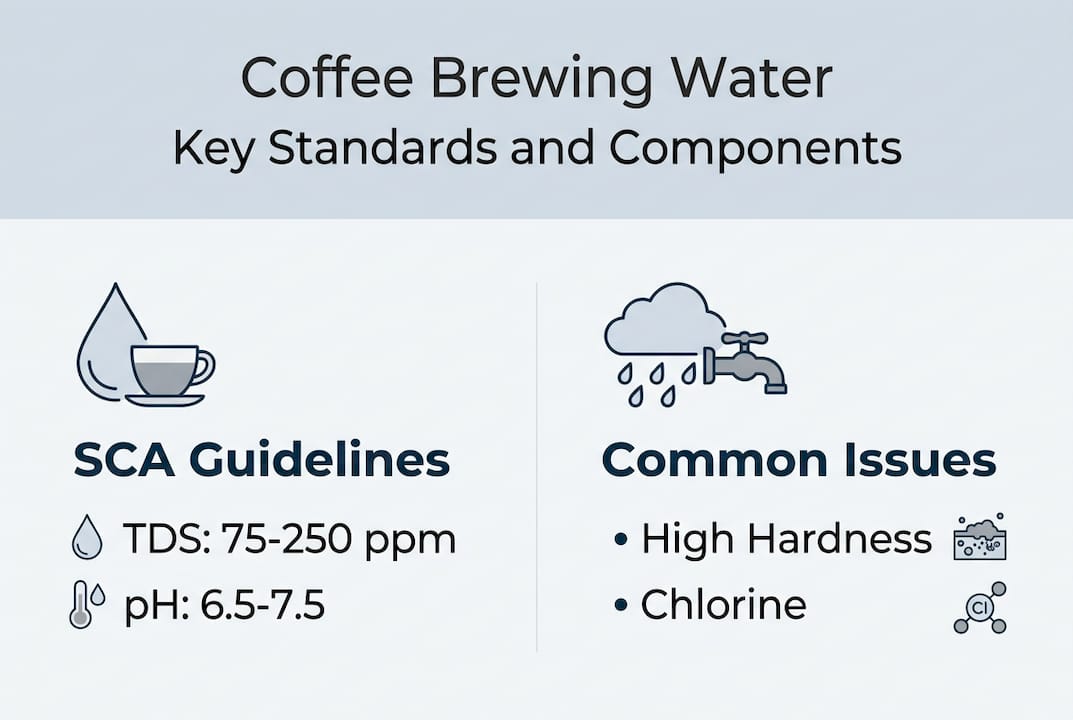
The SCA recommends TDS 75-250 ppm, alkalinity 40-70 ppm, and pH 6.5-7.5 for optimal brewing, with zero tolerance for chlorine or chloramine.
| Parameter | SCA recommended range | Typical tap water |
|---|---|---|
| TDS | 75-250 ppm (ideal ~150) | 50-500+ ppm |
| Calcium hardness | 50-175 ppm CaCO3 | Varies widely |
| Alkalinity | 40-70 ppm CaCO3 | Often 100-200 ppm |
| pH | 6.5-7.5 (target 7.0) | 6.5-8.5 |
| Chlorine | 0 ppm | 0.2-4 ppm |
Tap water in most cities sits well outside these ranges, especially on alkalinity and chlorine. That alone explains why brewing specialty coffee at home can feel inconsistent even when you do everything else right. Exploring specialty coffee options with water-forward brewing in mind changes the game entirely.
Comparing water standards: SCA guidelines vs. expert perspectives
The SCA guidelines are a reliable starting point, designed to work for a broad range of coffee styles and home setups. They are intentionally wide so that most brewers can hit them without advanced equipment. But some experts push further.
Scott Rao, one of the most respected voices in specialty coffee, advocates for tighter parameters, particularly lower alkalinity. His reasoning is that alkalinity below 40 ppm allows coffee’s natural acidity to shine through more clearly, which is especially important for light-roasted, single-origin coffees with delicate fruit or floral notes. He also emphasizes magnesium over calcium as the preferred mineral for extraction.
| Parameter | SCA range | Scott Rao’s approach |
|---|---|---|
| TDS | 75-250 ppm | ~150 ppm |
| Alkalinity | 40-70 ppm | Under 40 ppm |
| Key mineral focus | Calcium and magnesium | Magnesium emphasis |
| Chlorine | 0 ppm | 0 ppm |
For most home brewers, the SCA range is the right place to start. But if you are already dialing in your coffee tasting guide practice and want to go deeper, experimenting with lower alkalinity water can reveal a noticeably brighter, more expressive cup. This is especially worth trying when you are comparing Arabica coffee from different origins side by side, or running a coffee cupping checklist at home.
Pro Tip: Start by adjusting one variable at a time. Try the same beans with your current tap water, then with filtered water, then with a remineralized option. Keep notes on each cup. Your palate will tell you more than any chart.
Practical tips: How to get better brewing water at home
You do not need to build a water lab in your kitchen. A few targeted steps will get you most of the way there.
-
Taste your tap water first. Fill a glass, let it sit for a minute, and drink it plain. If you notice any chlorine smell, metallic taste, or flat quality, your water is already working against your coffee.
-
Use a carbon filter. Chlorine and chloramine in tap water create chemical off-flavors that no amount of good beans can overcome. A basic activated carbon filter, like a Brita pitcher or an under-sink carbon block, removes both effectively and affordably.
-
Check your water hardness. Many municipalities publish annual water quality reports online. You can also buy inexpensive test strips at hardware stores to measure TDS and hardness at home in under a minute.
-
Try remineralization. If your filtered water is too soft (under 75 ppm TDS), you can add minerals back using specialty products like Third Wave Water tablets or Barista Hustle’s water recipes. These are designed specifically for coffee and take the guesswork out of mineral ratios.
-
Consider bottled water as a benchmark. Some still mineral waters, like Volvic or Evian, fall close to SCA specs. Use them as a reference point to understand what well-balanced water tastes like in your cup before investing in a full filtration setup.
-
Avoid distilled or reverse osmosis water without remineralization. Completely stripped water has no minerals to assist extraction and will produce a flat, lifeless brew.
Pro Tip: Once you find a water setup that works, stick with it for a few weeks before changing anything else in your brew routine. Consistency in water makes it much easier to dial in your coffee bean selection and grind settings accurately.
Our take: What most guides miss about water in coffee brewing
Here is something we have noticed: the more detailed water guides get, the more they risk turning a joyful ritual into a homework assignment. Chasing exact ppm targets with precision scales and lab-grade reagents is genuinely useful for competition baristas. For the home brewer who loves a great cup in the morning, it can become a distraction.
The biggest wins come from the basics. Remove chlorine. Avoid very hard or very soft water. Stay within a reasonable mineral range. Those three steps alone will improve your cup more than most other tweaks combined.
After that, trust your palate more than your numbers. If a cup tastes bright and balanced, your water is working. If it tastes dull or sharp, adjust one thing and taste again. That iterative, curious approach is how you actually develop a feel for water in brewing, not by memorizing tables.
Our honest view: the best water for your coffee is the simplest water that tastes clean and neutral on its own. Pair that with exceptional specialty beans and you will be in a very good place without ever touching a TDS meter.
Brew better coffee with the right beans and tools
Understanding water is a meaningful step forward, but water alone cannot make a great cup. It needs something worth extracting.
At House Coffee, we source single-origin Arabica beans that are roasted fresh and shipped directly to your door, so the flavor potential is already there waiting to be unlocked. Our specialty coffee range includes carefully curated options for every palate, and our Gold Collection is a great place to start if you want beans that reward good water and careful brewing. We also carry coffee paper filters that work in harmony with your setup. Better water, better beans, better tools. That is the full picture.
Frequently asked questions
What is the best water to use for brewing coffee at home?
The best water meets SCA specs: TDS ~150 ppm, pH 6.5-7.5, calcium hardness 50-175 ppm, alkalinity 40-70 ppm, and completely free of chlorine or odors.
How do I know if my tap water is suitable for coffee?
If your coffee tastes flat or has a chemical edge, test for chlorine and hardness; a basic carbon filter resolves most tap water issues quickly and affordably.
Are bottled waters better for coffee than tap water?
Some bottled waters match coffee-friendly mineral specs well, but always check the label for TDS and mineral content, and avoid any water with added sodium.
Can I use distilled water for brewing coffee?
Distilled water has no dissolved minerals, which means it cannot extract coffee compounds properly and typically produces a flat, sour, or lifeless cup.
What’s the easiest way to improve coffee water at home?
A simple carbon filter removes chlorine and off-odors effectively, and SCA-compatible mineral tablets let you remineralize filtered water for consistent, brew-ready results.
Recommended
- How to Select Coffee Beans for a Premium Brew – House Coffee
- Explaining coffee flavor notes: a guide for enthusiasts – House Coffee
- Why freshness matters in coffee for the best brew – House Coffee
- How to Brew Specialty Coffee for Rich, Authentic Flavor – House Coffee
- Coffee Making – Autoryzowany dystrybutor i serwis Jura Wrocław
-
Posted in
en, role of water in brewing coffee