Coffee certification explained: labels for quality and ethics

TL;DR:
- Certifications verify that coffee farms meet social, environmental, and economic standards through independent audits. They provide premiums for farmers, supporting sustainable livelihoods and better practices. However, certifications do not guarantee coffee quality, and costs may be barriers for smallholders.
You’ve probably picked up a bag of coffee and noticed a cluster of small logos near the bottom: a green frog, a fair trade symbol, maybe a USDA organic seal. Most coffee drinkers see those labels every day and assume they signal something good, but most consumers can’t explain what each one actually means or how it affects the coffee in their cup. Certifications touch everything from the pesticides used on a farm to the minimum price a grower receives for their harvest. Understanding them doesn’t just make you a more informed shopper. It connects you to the people and places behind every sip.
Table of Contents
- What is coffee certification and why does it matter?
- How the coffee certification process works
- Decoding the main coffee certifications: Organic, Fairtrade, Rainforest, 4C
- What most people miss: Real-world challenges, limits, and choosing the right cert
- House Coffee’s perspective: How to buy coffee that truly aligns with your values
- Discover specialty coffee: Taste and ethics you can trust
- Frequently asked questions
Key Takeaways
| Point | Details |
|---|---|
| Certification assures standards | Coffee certification programs provide verified assurances of social, environmental, or economic standards. |
| Each label has trade-offs | Organic, Fairtrade, Rainforest, and 4C each focus on different priorities, so choose based on your values. |
| Certification is not quality | Look for both certification and a specialty grade (SCA 80+) for the best ethical and flavor experience. |
| Ask for transparency | Always check certifier logos, documentation, and traceability to make informed purchase decisions. |
What is coffee certification and why does it matter?
At its core, a coffee certification is a voluntary label. It signals that an independent, third-party auditor has verified that a farm, cooperative, or supply chain meets a defined set of standards. Those standards can cover social conditions, environmental practices, economic fairness, or cup quality, depending on the program. Coffee certifications are voluntary programs verified by independent third-party auditors ensuring production meets specific social, environmental, economic, and quality standards, with premiums paid to certified farmers.
That last part matters. Premiums. Certified farmers often receive a price above the commodity market rate, which can mean the difference between a sustainable livelihood and poverty-level income. For smallholder farmers working just a few hectares, that premium can fund school fees, better equipment, or crop improvements.
Here’s why certifications have become so central to the specialty coffee world:
- They provide independent verification that a claim is real, not just marketing.
- They create price floors and premiums that protect growers from volatile markets.
- They give consumers a shortcut for ethical decision-making when full sourcing information isn’t available.
- They push farms toward better environmental practices, from water management to biodiversity protection.
- They build trust across a long, complex supply chain that spans continents.
If you’re already curious about why choose specialty coffee, understanding certifications is the natural next step. And if you want to see how growers elevate specialty coffee through quality and ethics, certifications are often part of that story.
Pro Tip: A certification doesn’t replace a conversation with your roaster. Ask where the coffee comes from and whether the farm has direct relationships with buyers. Certification plus traceability is a powerful combination.
The bottom line: certifications exist because the global coffee supply chain is long and complicated. Without them, a consumer in Toronto has almost no way to verify what happened on a farm in Ethiopia or Colombia.
How the coffee certification process works
Getting certified isn’t a one-time checkbox. It’s an ongoing commitment that requires time, documentation, and consistent practice. Here’s how the process typically unfolds:
- Application: The farmer or cooperative applies to an accredited certifying body and pays an initial fee.
- Internal management system (IMS) setup: The farm builds a traceability and compliance system, documenting inputs, yields, labor practices, and environmental measures.
- On-site audit: An independent auditor visits the farm to verify that practices match the documentation.
- Certification issued: If the farm passes, certification is granted, typically valid for one to three years.
- Annual surveillance: Most programs require yearly check-ins or documentation updates between full audits.
- Re-audit and renewal: At the end of the certification period, the full audit process repeats.
The certification process requires farms to build internal management systems for traceability and compliance, undergo on-site audits, complete annual surveillance, and maintain supply chain integrity through mass balance or physical traceability methods.
Traceability is a key word here. Supply chains use two main methods: physical traceability, where certified beans are kept separate from uncertified ones throughout processing and shipping, and mass balance, where certified volumes are tracked numerically but may be mixed physically. Mass balance is more common and more practical at scale, but it means the bag in your hand might not contain the exact beans from the certified farm on the label.
For a deeper look at ethical coffee sourcing and what it really means in practice, the supply chain mechanics matter as much as the label itself. Getting familiar with specialty coffee terminology also helps you ask better questions.
The 4C certification process is one of the more accessible entry points for farmers new to formal certification, with a lighter documentation burden than programs like Fairtrade or Organic.
Pro Tip: When buying certified coffee, ask your roaster whether they use physical traceability or mass balance. Physical traceability means the certified beans in the bag are the actual beans from the certified farm.
Decoding the main coffee certifications: Organic, Fairtrade, Rainforest, 4C
Not all certifications are built the same. Each one prioritizes different values, and knowing the differences helps you choose what actually aligns with your priorities.
| Certification | Primary focus | Synthetic inputs | Price guarantee | Entry difficulty |
|---|---|---|---|---|
| Organic | Environmental/health | Banned | None | High |
| Fairtrade | Social/economic | Restricted | Yes (minimum price) | Medium |
| Rainforest Alliance | Ecosystem/social | Some allowed | None | Medium |
| 4C | Baseline sustainability | Reduced | None | Low |
Organic is the most restrictive on inputs. Organic requires a 3-year chemical-free transition, detailed records, annual inspections, and prohibits GMOs and synthetic pesticides or fertilizers. Exporting to the EU adds electronic certificates of inspection. This is the certification for consumers focused on what goes into their body and into the soil.
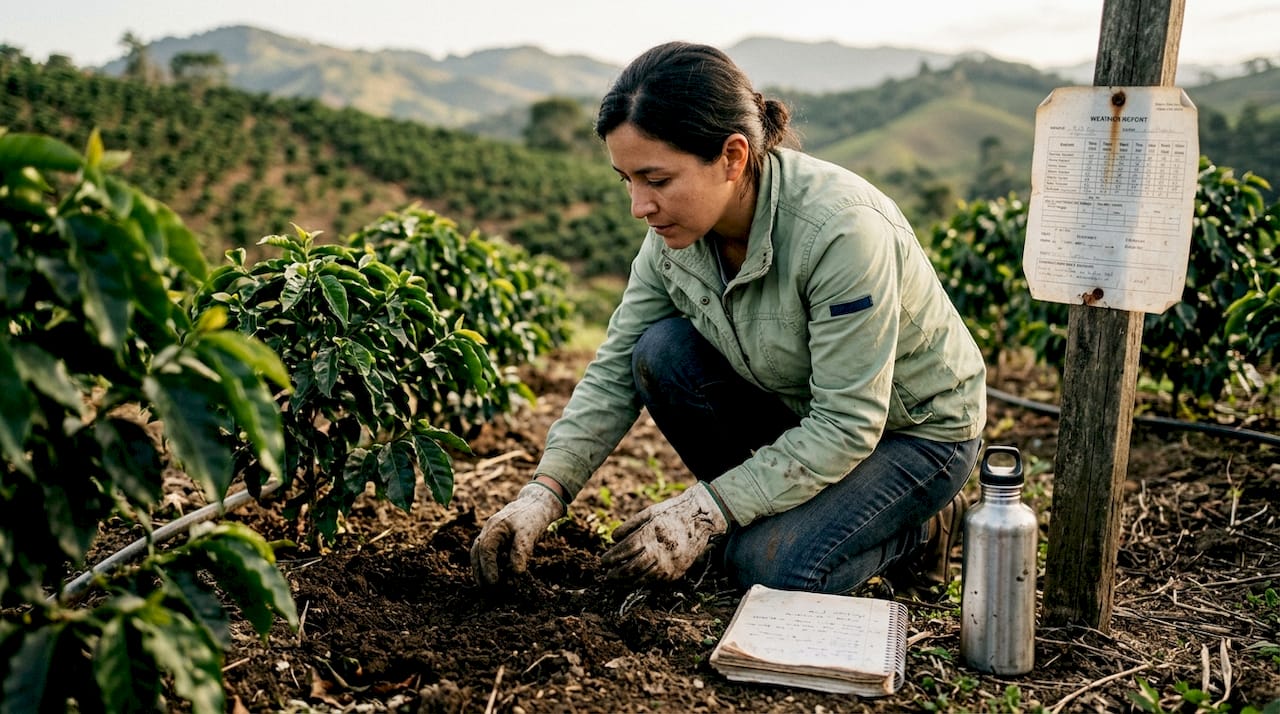
Fairtrade focuses on economic and social justice. Fairtrade core requirements cover minimum prices and premiums written into contracts, restrictions on the worst pesticides, worker rights protections, and geolocation data for deforestation monitoring. The premium is democratically allocated by the farmer cooperative, meaning growers decide how to spend it.
Rainforest Alliance balances ecosystem health, social standards, and economic viability. It allows some synthetic inputs under strict conditions, which makes it more achievable for farms in regions where organic transition is economically risky. It’s strong on biodiversity and water protection.
4C (Common Code for the Coffee Community) is an entry-level sustainability standard. It covers the basics: no worst-form child labor, no forced labor, no destruction of high-conservation-value areas, and reduced agrochemical use. It’s designed to bring more farmers into the sustainability conversation, even if they’re not ready for a full Fairtrade or Organic audit.
Here’s a quick guide to matching certifications with your values:
- Health-focused: Prioritize Organic.
- Farmer income: Prioritize Fairtrade.
- Biodiversity and ecosystem: Prioritize Rainforest Alliance.
- Broad sustainability access: Look for 4C as a baseline.
Browsing the specialty coffee collection with this framework in mind makes it much easier to find coffees that reflect what you care about. And understanding what is specialty coffee quality adds another layer to the picture.
What most people miss: Real-world challenges, limits, and choosing the right cert
Certifications are valuable. They’re also imperfect. Here’s what most guides skip over.
Cost is a real barrier. High certification costs can burden smallholders, with fees reaching $58 per hectare for Rainforest Alliance. Premiums may not always offset these costs, especially when certified demand is low or inconsistent. That means some of the most ethical, careful farmers in the world grow uncertified coffee simply because the paperwork and fees are out of reach.
Certification doesn’t equal quality. Certification labels do not guarantee cup quality. The best approach is to pair a sustainability certification with an SCA specialty score of 80 or above. A coffee can be fully Fairtrade certified and still taste flat or generic. Conversely, some of the most extraordinary coffees in the world come from farms that are organic by practice but not by paperwork.
Greenwashing is real. Some brands use certification logos loosely or feature them prominently while sourcing only a small fraction of their coffee from certified farms. Always check whether the certification applies to the specific product, not just the company.
Here’s a practical checklist for cutting through the noise:
- Look for the certifying body’s official logo on the specific product, not just the brand.
- Ask for the SCA score if quality matters to you.
- Check whether the brand publishes sourcing details, not just certification badges.
- Consider eco-friendly coffee sourcing practices beyond formal certification.
- Pair certification with SCA score coffee quality indicators for the full picture.
- Explore single-origin coffee ethics as a complement to certification programs.
Pro Tip: Direct trade relationships, where a roaster buys directly from a specific farm at a negotiated premium, often provide more transparency than any certification label. Look for roasters who publish farm names, harvest years, and purchase prices.
House Coffee’s perspective: How to buy coffee that truly aligns with your values
After years of sourcing and tasting, we’ve come to a clear conclusion: there is no perfect certification. Every program has trade-offs. Organic protects the environment but doesn’t guarantee farmer income. Fairtrade supports growers economically but allows some practices that environmentalists would question. Rainforest Alliance covers a lot of ground but permits synthetic inputs that organic buyers avoid.
The most experienced coffee buyers we know don’t chase a single label. They look for a combination: a credible certification as a baseline, full traceability back to a specific farm or cooperative, a published SCA score above 80, and a roaster willing to talk openly about their sourcing relationships.
When exploring specialty coffee, treat certifications as a starting point, not a finish line. Ask questions. Read the sourcing notes. Look for brands that show their work rather than just wearing a badge. The best coffees we’ve found come from coffee grower insights built on real relationships, not just compliance checkboxes.
Your values are your compass. Use certifications as one tool among many, and you’ll make choices you feel genuinely good about.
Discover specialty coffee: Taste and ethics you can trust
With a clearer understanding of what certifications actually mean, finding coffee that matches your values becomes a lot more straightforward.
At House Coffee, every coffee in our lineup is sourced with traceability and ethics at the center. We focus on single-origin Arabica beans with documented sourcing, so you know exactly where your coffee comes from and how it was grown. Whether you’re ready to buy specialty coffee for everyday brewing or want to explore our curated Gold Collection for something truly exceptional, you’ll find coffees that reflect the values you’ve just read about. Taste the difference that responsible sourcing makes.
Frequently asked questions
What does coffee certification guarantee?
Coffee certification guarantees that specific standards have been verified by independent third-party auditors, covering social, environmental, or economic practices. It does not guarantee flavor or overall cup quality.
Are certified coffees always better quality?
No. A certification label does not guarantee cup quality. For the best results, look for both a sustainability certification and an SCA score above 80, which indicates specialty-grade coffee.
How do I know if a certification is real?
Check for the certifying body’s official logo on the specific product, verify supply chain traceability details, and ask the roaster for supporting documents if you’re uncertain.
What is the cost for farmers to get certified?
Certification costs can burden smallholders, with fees reaching $58 per hectare for Rainforest Alliance, plus audit costs and annual renewal fees that may not be offset by premiums if certified demand is low.
Recommended
-
Posted in
coffee certification explained, en